Getting into the IT industry as a fresher can feel confusing.
You may have completed your BSc, BCA, BCom, BBA, BE, B.Tech or another degree and started wondering:
“What should I learn?”
“Do I need to know coding?”
“Which IT job should I apply for?”
“How do companies select freshers?”
There is a lot of information available online, but sometimes that information creates even more confusion.
Some people say you must learn many programming languages. Others say you need advanced coding, data structures, cloud, AI and many other technologies before applying for your first job.
The reality is much simpler.
You don’t need to know everything before getting your first IT job.
You need to understand where you want to start, learn the required basics, practice them, build some confidence and then start applying.
In this guide, let’s understand the complete journey from being a beginner to getting your first opportunity in IT.
What Does Getting Into IT Actually Mean?
When people hear the word IT, many immediately think about software developers sitting in front of computers and writing code.
But the IT industry is much bigger than software development.
Companies need people for software development, testing, technical support, cloud operations, data, cybersecurity, business analysis and many other areas.
For example, a software application may involve several different people:
Business Analyst → Developer → Tester → Cloud/DevOps → Support
Each person has a different responsibility.
So your first goal shouldn’t be: “I need to become a software developer.”
Instead, your first goal should be:
“I need to understand which IT role is suitable for me and then build the skills required for that role.”
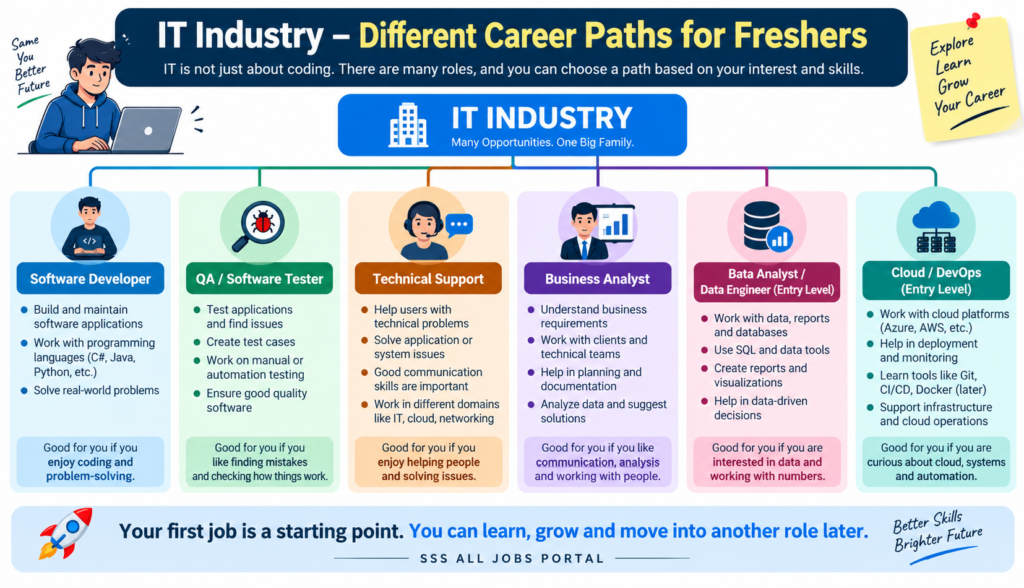
Which IT Roles Can a Fresher Choose?
There isn’t one single path into IT.
Depending on your education, interest and skills, you can explore different entry-level roles.
Software Developer:
Developers build and maintain software applications.
If you enjoy programming and solving problems, development can be a good option.
Common technologies include:
- C#
- Java
- Python
- JavaScript
- SQL
QA / Software Tester:
Testers check whether an application is working correctly.
They find problems, create test cases and work with developers to get issues fixed.
Technical Support:
Technical support professionals help users solve application, system or technical problems.
Communication skills and basic technical knowledge are important for these roles.
Business Analyst:
Business analysts work more closely with business requirements.
They help understand what the customer needs and communicate those requirements to the technical team.
Data-Related Roles :
Some entry-level roles involve working with data, reports and databases.
SQL and basic analytical skills can be useful here.
The important thing is that you don’t have to decide your entire career on day one.
Your first job is a starting point. You can learn more and move into another role later.
Step 1 – Understand Your Career Direction
Before opening a programming tutorial, spend some time understanding what you actually want.
Ask yourself a few simple questions:
Do I enjoy solving problems?
Am I interested in programming?
Do I enjoy working with computers and technology?
Am I comfortable communicating with people?
Would I prefer technical work or business-related work?
Your answers can help you choose a direction.
For example, if you enjoy coding and logical problem-solving, software development could be worth exploring.
If you enjoy finding mistakes and checking how things work, software testing may interest you.
If you enjoy helping people and solving their technical issues, support roles may be a good starting point.
Step 2 – Learn the Basics
Once you select a direction, don’t immediately jump into advanced topics.
Start with the fundamentals.
If you want to become a developer, understand things such as:
- What is programming?
- What is a programming language?
- What is a variable?
- What is a method?
- What is a condition?
- What is a loop?
- What is an object?
- What is a database?
- What is an API?
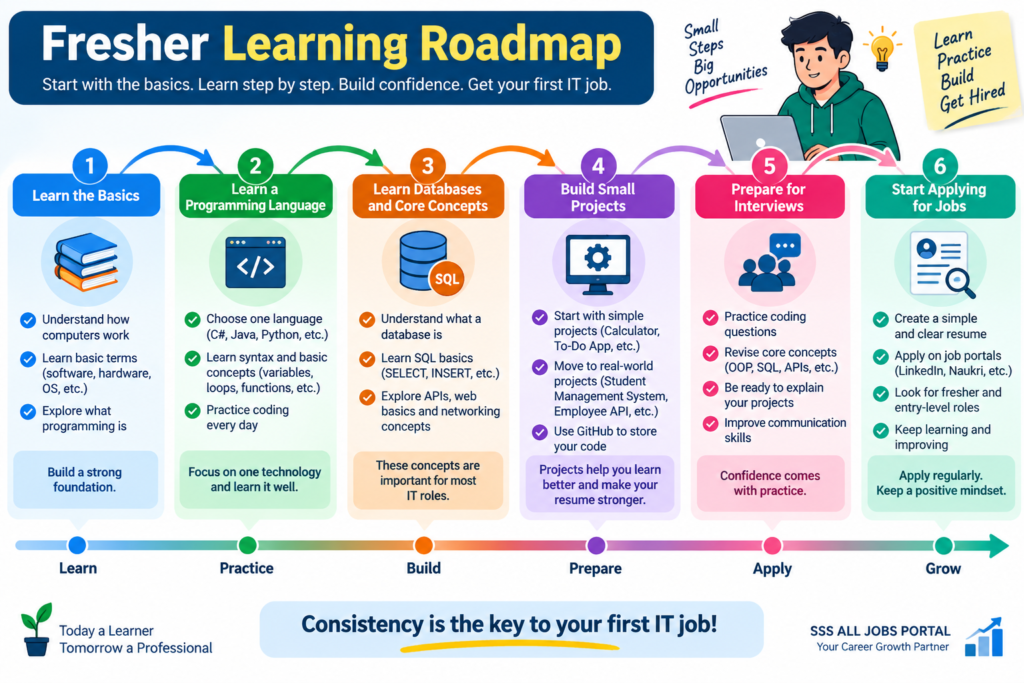
These may look like very basic topics, but they become important later.
Imagine trying to build a house without understanding bricks, cement and basic construction.
Programming works in a similar way. Strong basics make advanced topics easier.
Don’t jump to advanced technologies before understanding the foundation.
Step 3 – Choose One Technology
One common mistake among freshers is trying to learn everything at once.
They start with:
Java + Python + C# + React + Angular + AWS + Azure + Docker + AI
After a few weeks, they know a little about everything but cannot confidently explain any one technology.
Don’t do that.
Choose one primary technology and learn it properly.
For example, if you decide to follow the .NET path, you can gradually learn:
C# → .NET → ASP.NET Core → Web API → SQL → Git → Cloud basics
You don’t need to learn everything in one month.
Learning is a process.
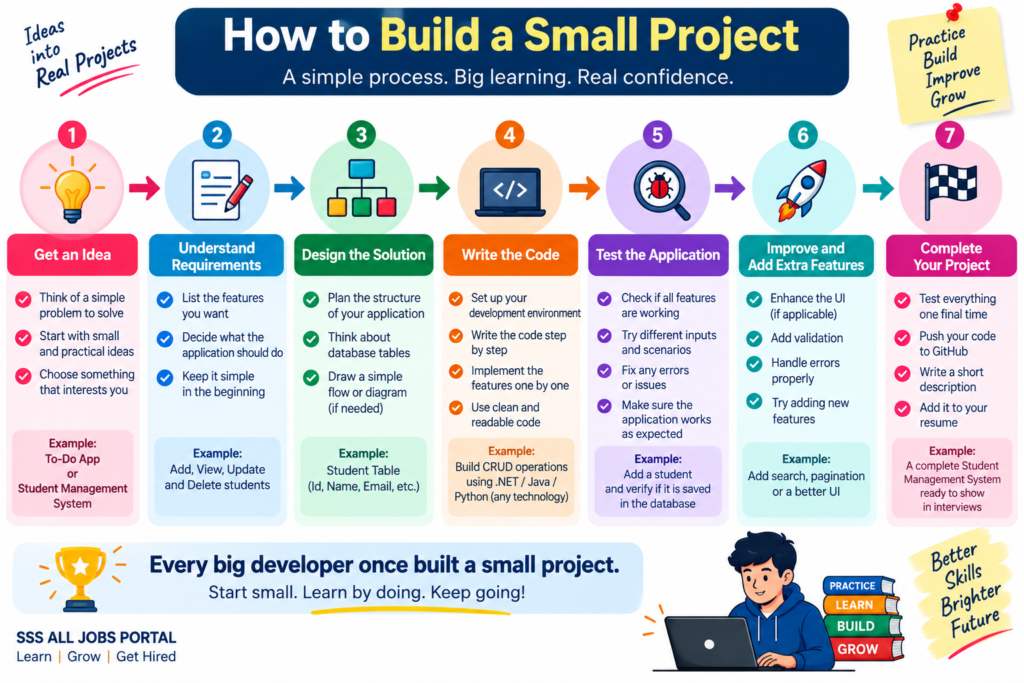
Step 4 – Practice by Building Small Projects
This is where your learning starts becoming real.
Watching 100 programming videos doesn’t necessarily mean you can build an application.
Try creating small projects.
For example:
Beginner projects
- Calculator
- To-do application
- Student management system
- Employee management system
After understanding the basics, you can move towards something more realistic.
For example:
Student Management API
A user might be able to:
- Add a student
- View students
- Update student information
- Delete a student
Now you’re not just learning syntax.
You’re starting to understand how software actually works.
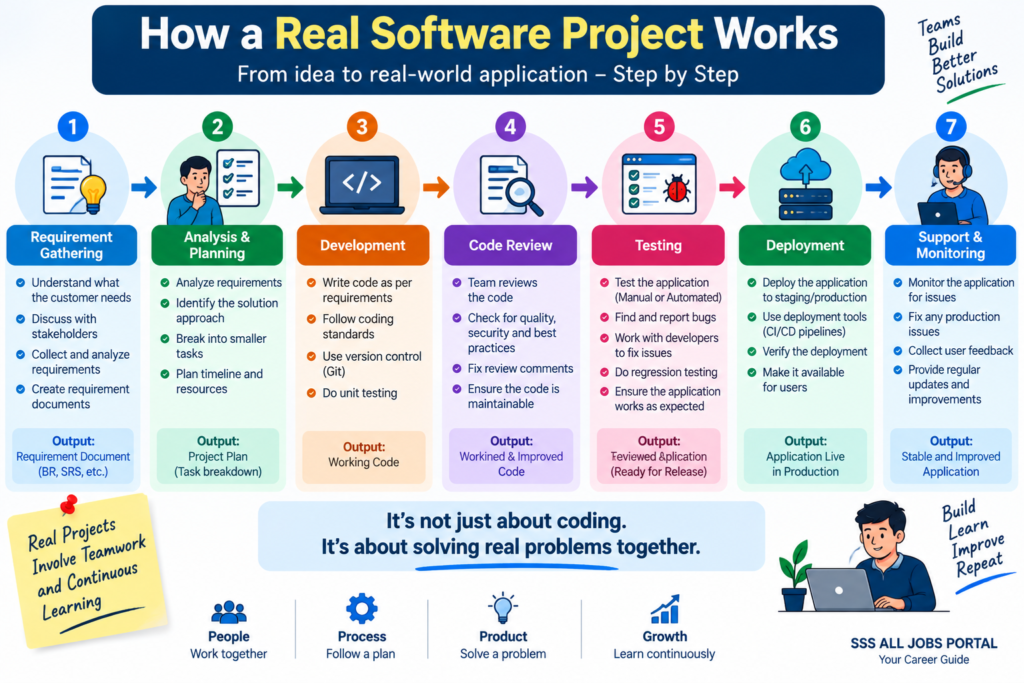
Step 5 – Understand How Real Software Projects Work
This is something many freshers don’t learn before joining their first company.
They learn programming but don’t understand what happens inside an actual IT project.
Real software development is not simply:
“Open Visual Studio → Write Code → Finish.”
A project normally starts with a requirement.
For example, imagine a company wants an application that allows customers to place orders.
Someone first needs to understand the requirement.
Then the technical team plans the solution.
Developers write the code.
Testers test the application.
The code may go through a review process.
After testing and approval, it can be deployed.
Then the application needs monitoring and support.
Step 6 – Prepare Your Resume
Once you have learned the basics and completed some projects, prepare your resume.
A fresher’s resume doesn’t need to be filled with 20 technologies.
Keep it simple.
Your resume can include:
Education
Your degree, college and graduation year.
Technical Skills
Only mention technologies that you actually know.
Projects
Mention 2–3 useful projects and explain what you built.
For example:
Student Management API
Developed a basic Web API for managing student records using C#, ASP.NET Core and SQL Server.
If you have a GitHub account or portfolio, you can include it as well.
One important rule:
Don’t add a technology just because you saw it in a job description.
If an interviewer asks you about it, you should at least understand what you have mentioned.
Step 7 – Prepare for Interviews
Now comes the part that many freshers worry about.
The interview.
For entry-level roles, interview preparation should focus on the fundamentals required for your chosen role.
For a developer role, you might need to prepare:
- Programming basics
- OOP concepts
- SQL basics
- Your projects
- Basic problem-solving
- Web/API fundamentals
- Questions about your resume
But don’t just memorize answers.
Try to understand the concept.
For example, instead of memorizing:
“An API is an Application Programming Interface…”
try to understand what actually happens when one application communicates with another.
That understanding will help you answer follow-up questions naturally.
Step 8 – Start Applying for Jobs
This is where many freshers wait too long.
They keep saying:
“I’ll apply after I learn one more technology.”
Then another technology comes along.
Then another.
Eventually, months pass.
You don’t need to wait until you feel 100% ready.
Once you have the basic skills required for an entry-level role and can explain your projects confidently, start applying.
Look at:
- Company career pages
- Job portals
- Campus opportunities
- Walk-in drives
- Fresher hiring programs
And keep improving your skills while applying.
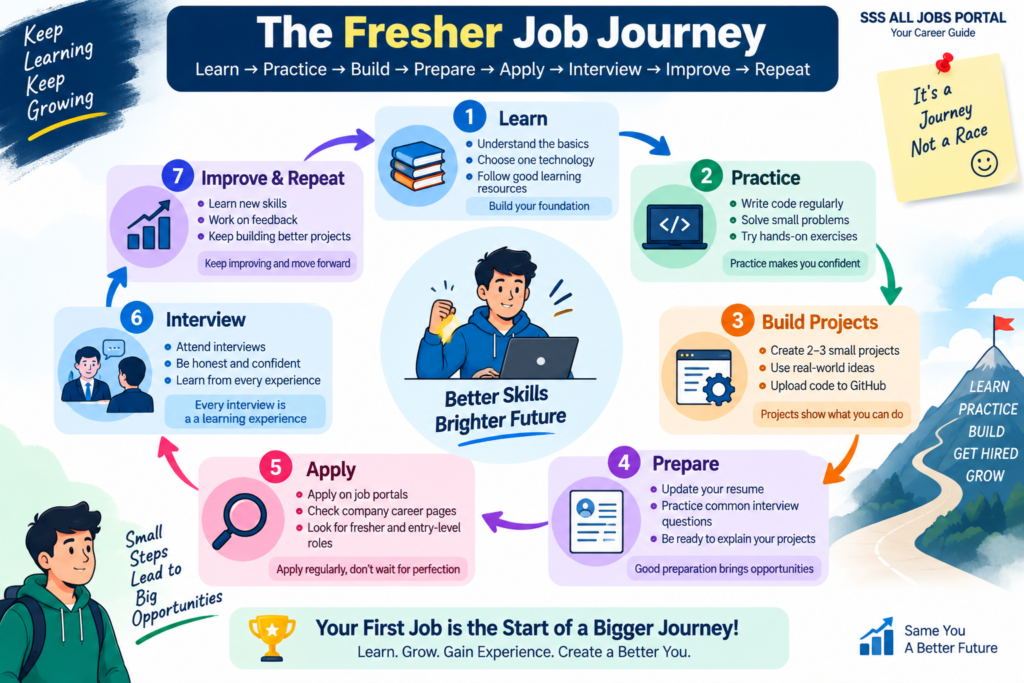
Common Mistakes Freshers Should Avoid
Trying to learn everything:
You don’t need ten technologies to get started.
Choose one direction and build a strong foundation.
Only watching tutorials:
Watching someone else write code is not the same as writing it yourself.
Open your computer and practice.
Copying projects:
A project copied completely from YouTube won’t help much if you cannot explain it during an interview.
Understand what you build.
Waiting for the perfect time to apply:
You will probably never feel completely ready.
Start applying when you have a reasonable foundation.
Adding fake skills to your resume:
This can create problems during interviews.
Be honest about what you know.
Comparing yourself with others:
One person may get a job in three months.
Another may take a year.
Everyone’s journey is different.
Focus on your own progress.
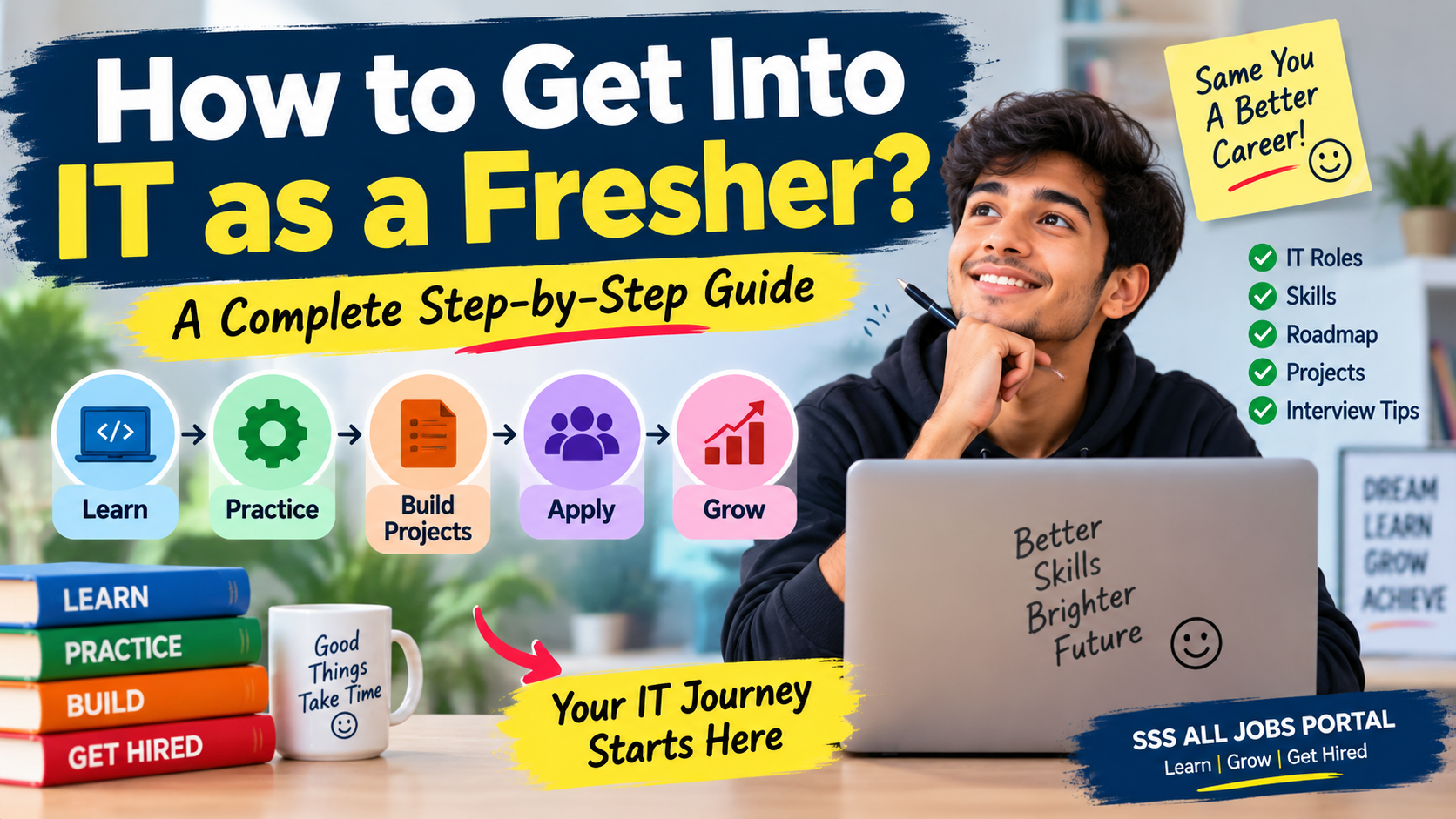
A Simple Roadmap You Can Follow
If you’re completely confused about where to begin, use this simple approach:
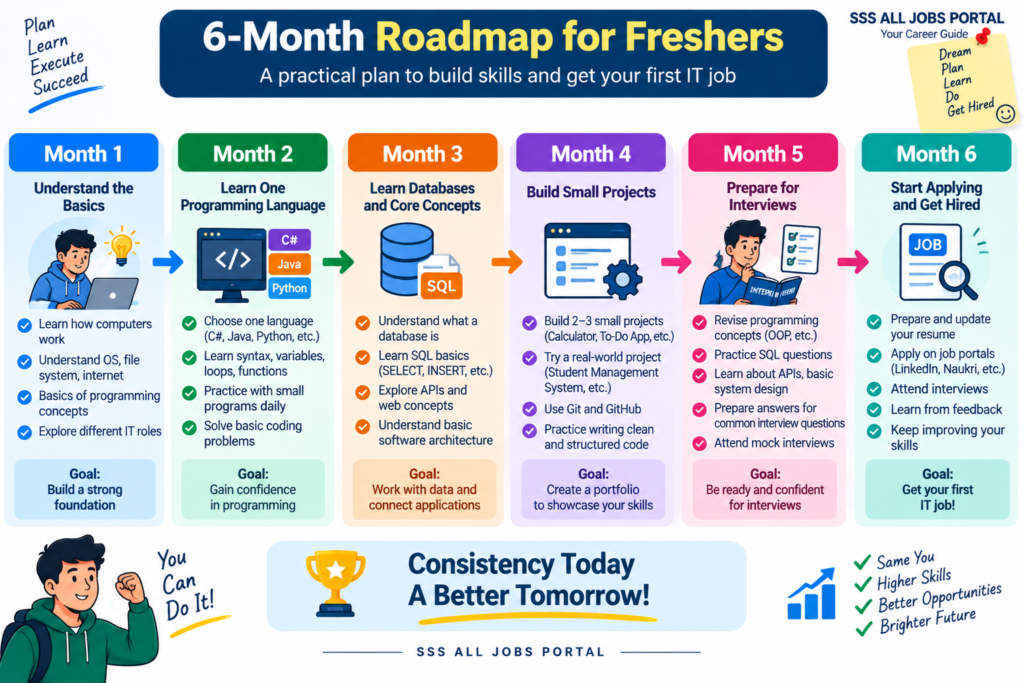
Month 1
Understand computer and programming basics.
Month 2
Learn one programming language.
Month 3
Learn databases and basic application concepts.
Month 4
Build small projects.
Month 5
Learn Git, APIs and basic software development concepts.
Month 6
Prepare your resume, practice interviews and start applying.
This is only an example roadmap. Some people may move faster, while others may need more time.
Consistency is more important than speed.
Final Thoughts
Getting your first IT job can look difficult when you see the number of technologies companies use.
But remember one thing:
You don’t have to learn the entire IT industry before getting your first job.
Start with one direction and learn the fundamentals required for it. Practice regularly and build a few small projects so that you can understand what you are learning instead of only watching tutorials.
As you become more comfortable, start learning how real software teams work. Prepare your resume, practice common interview questions, understand your projects well and start applying for suitable entry-level opportunities.
You don’t need to wait until you feel completely ready. Keep learning while you apply, and use every interview as an opportunity to understand where you can improve.
Your first opportunity can give you something much more valuable — real experience.
Once you enter the industry, you can learn new technologies, work with experienced people and understand how software is actually built in the real world.
So don’t wait until you know everything.
Start small. Learn consistently. Build something. Apply. Improve. Repeat.
Your IT career has to start somewhere.
Why not start today?
For more articles, please visit our website regularly. Thanks everyone and happy learning!