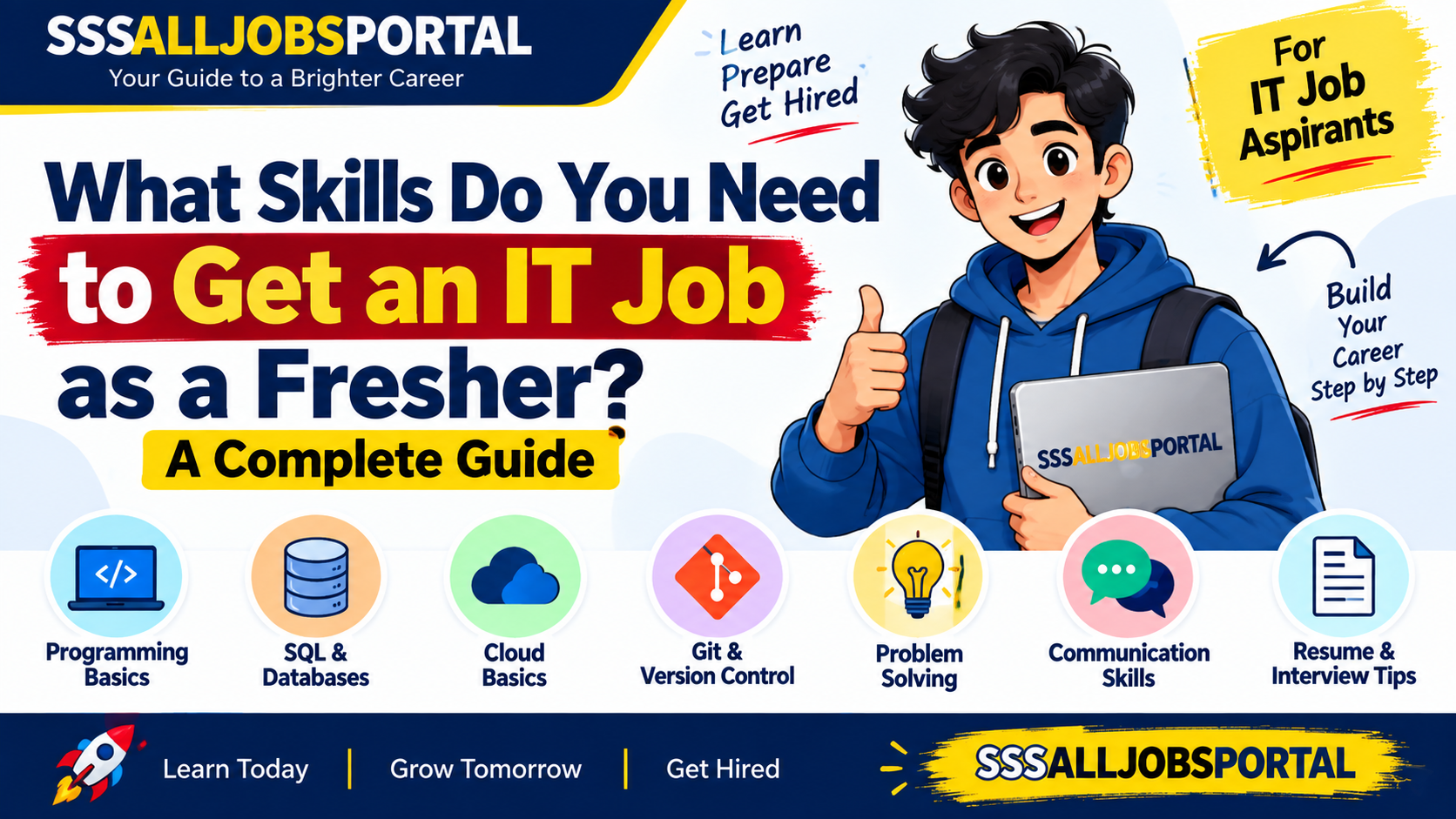
Starting a career in IT can feel confusing because every job notification seems to ask for a different set of skills. One company may mention programming, another may ask for SQL, while another may focus more on communication and problem-solving. As a fresher, you may start wondering whether you need to learn everything before applying for your first job.
The good news is that you don’t need to know everything to get your first IT job. Companies understand that fresh graduates are still learning. What they usually want to see is a good foundation, the ability to learn, basic technical knowledge relevant to the role, and the confidence to work with others. In this article, let’s understand the important skills that can help you become more job-ready as a fresher.
Basic Programming Knowledge:
If you are planning to apply for a software development or technical role, having basic programming knowledge is one of the most useful skills you can develop. You don’t necessarily need to become an expert programmer before applying for your first job, but you should understand how programs work and be comfortable writing simple code.
Start with one programming language rather than trying to learn five languages at the same time. Depending on your career interest, you could start with languages such as C#, Java, Python or JavaScript. Learn fundamentals like variables, data types, conditions, loops, functions, arrays and basic object-oriented concepts. Once you understand these concepts, you can gradually move toward more advanced topics.
For example, if an interviewer asks you to write a program to find the largest number in an array, they are not only checking whether you remember syntax. They are also interested in how you approach the problem and explain your solution. Strong fundamentals are more valuable than simply knowing many programming languages.
SQL and Database Basics
Many freshers ignore databases because they think SQL is only required for database administrator roles. In reality, basic database knowledge can be useful for many IT positions, especially software development, testing, support and data-related roles.
You should understand what a database is and become comfortable with basic SQL queries. Start with concepts such as tables, rows, columns, primary keys and relationships. Then learn common queries using SELECT, WHERE, ORDER BY, GROUP BY and JOIN. You don’t need to master every advanced SQL feature before applying for your first job.
For example, imagine a company has an employee database containing employee names, departments and salaries. If an interviewer asks you to find employees belonging to a particular department or identify the highest salary, basic SQL knowledge allows you to approach the problem confidently. These small concepts can make a big difference during technical interviews.
Understanding of Your Chosen Role
One mistake many freshers make is learning random technologies without understanding the role they are targeting. Instead of trying to learn everything, first decide what kind of job you want to pursue and then identify the skills commonly associated with that role.
For example, someone interested in a software developer position may focus on programming, databases, APIs and development tools. Someone interested in software testing may focus on testing concepts, test cases, automation basics and defect management. A candidate targeting a technical support position may need troubleshooting, operating-system basics, networking fundamentals and communication skills.
You don’t have to know every technology mentioned in every job description. Your goal should be to build a strong foundation for the type of role you want to enter and then continue learning after you get the job.
Problem-Solving Skills
Technical knowledge is important, but companies also want people who can think through problems. You may know the syntax of a programming language, but if you don’t know how to approach a problem, writing code becomes difficult.
You can improve problem-solving by practicing small programming problems regularly. Start with simple tasks such as reversing a string, checking whether a number is prime, finding duplicates in an array or counting the frequency of characters. The objective isn’t to solve hundreds of difficult coding problems. Instead, focus on understanding how to break a problem into smaller steps.
For example, if you are asked to build a simple application, don’t immediately start writing code. First ask yourself: What is the input? What should the application do with that input? What should the output look like? Breaking problems into these smaller parts is a skill that will help you throughout your IT career.
Communication Skills
Good communication is important even when you are applying for a highly technical position. In a real software company, developers regularly communicate with team members, testers, project managers, clients and other departments.
You don’t need to speak perfect English or use complicated words. What matters more is being able to understand a question, explain your thoughts clearly and communicate professionally. During an interview, if you don’t know an answer, it is better to honestly say that you don’t know and explain how you would learn it than to confidently give an incorrect answer.
You can improve communication by speaking about your technical topics regularly. Pick something you learned that day and try explaining it in simple words, as if you were teaching it to another person. This practice can improve both your communication and your understanding of the subject.
Git and Basic Development Tools
If you are interested in software development, it is useful to have a basic understanding of Git and version control. You don’t need to become a Git expert as a fresher, but you should understand why developers use version control and become familiar with basic operations.
Learn concepts such as repositories, commits, branches, pull requests and merging. You can create a small project and upload it to GitHub while learning these concepts. This gives you practical experience instead of simply mentioning Git on your resume.
Even a small project can demonstrate that you understand how developers manage and share their code. It also gives interviewers something practical to discuss with you.
A Small Project You Can Explain
A project can be one of the best ways for a fresher to demonstrate their skills. It doesn’t need to be a huge application with dozens of features. A small, working project that you understand completely can be much more useful.
For example, you could create a simple employee management application, expense tracker, task management application or job-search tracker. Depending on your skill level, it could contain basic features such as adding records, updating information, deleting records and searching data.
The most important part is that you should be able to explain your project. Be prepared to answer questions such as: Why did you build it? Which technologies did you use? How does the application work? What problems did you face? How did you solve them? Understanding your own project is more important than having a complicated project title on your resume.
Willingness to Learn
Technology changes continuously, so companies don’t expect a fresher to know everything. What can make you stand out is your willingness and ability to learn.
During interviews, companies may ask questions about technologies that you haven’t worked with before. Instead of feeling discouraged, understand that learning unfamiliar technologies is part of working in IT. If you have a strong foundation, learning a new framework or tool becomes much easier.
You can demonstrate this mindset through your projects, certifications, internships, college work or even personal learning. Instead of saying only, “I know this technology,” try to understand how you learned it and what you built with it.
Resume and Interview Readiness
Even if you have good technical skills, you need to present them properly. Your resume should clearly show your education, relevant skills, projects, internships or experience. Avoid filling your resume with technologies that you have never actually used just because they appear in a job description.
Before attending an interview, read the job description carefully and prepare around the skills mentioned there. Revise your programming fundamentals, SQL, projects and common HR questions. Most importantly, be ready to explain everything written on your resume.
A fresher doesn’t need a resume full of achievements to get started. A clear, honest and well-organized resume can make it easier for recruiters to understand your profile.
You Don’t Need to Learn Everything
One of the biggest problems freshers face is trying to learn too many things at once. They start C#, then move to Java, then Python, then cloud computing, then AI, then cybersecurity—and eventually feel that they don’t know anything properly.
Instead, choose a direction and build your skills step by step.
For example:
Choose a role → Learn the fundamentals → Practice → Build a small project → Create your resume → Prepare for interviews → Start applying
Once you enter the industry, you can continue expanding your skills based on your role and career goals.
A Simple Skill Roadmap for Freshers
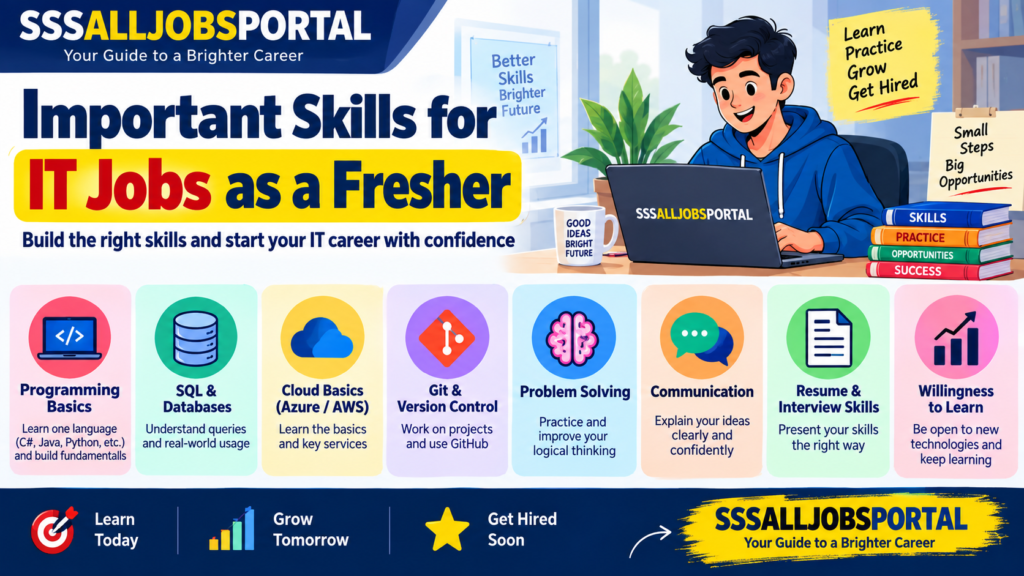
You can think about your preparation in six simple stages:
1. Choose your target role
↓
2. Learn the required fundamentals
↓
3. Practice regularly
↓
4. Build one or two small projects
↓
5. Prepare your resume and interview skills
↓
6. Start applying and continue learning
You don’t have to wait until you feel 100% ready. There is no point at which you will know everything. Start applying when you have a reasonable foundation and keep improving based on the requirements you see in real job openings.
Final Thoughts
Getting your first IT job is not about knowing every technology in the market. Companies understand that freshers are at the beginning of their careers. What matters is having the right foundation, understanding the role you are targeting, being able to solve basic problems, communicating clearly and showing that you are willing to learn.
Instead of asking yourself, “Do I know enough to get an IT job?”, ask a better question: “What skills does the role I want require, and what can I learn next?” That mindset will help you stay focused and make steady progress.
Your first job is only the beginning of your IT career. Once you enter the industry, you’ll continue learning new technologies, working on real projects and developing skills that you simply cannot learn from tutorials alone.
Keep learning, keep practicing and keep applying. Your first opportunity may be closer than you think.